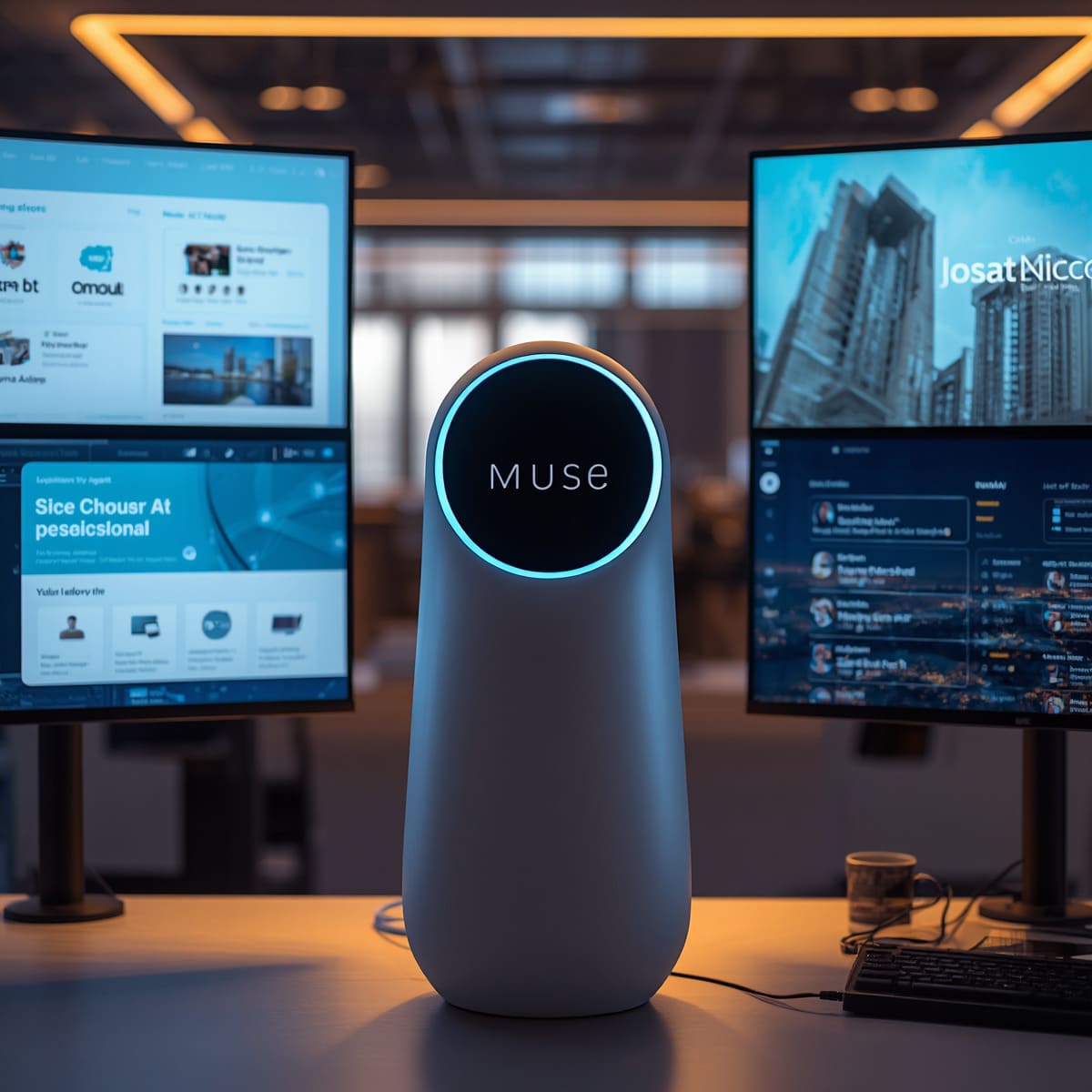
Meta has entered the AI agent race with Muse, a personal AI agent designed to move past chatbot-style Q&A and actually take action on a user’s behalf. Rolled out to adults in the US on Tuesday, Muse can manage schedules, draft and send emails, book travel, compare prices, shop, fill out forms, and execute multi-step tasks across a user’s connected apps – with minimal supervision once a goal is set.
What Muse Actually Does
Built on Meta’s Muse Spark model family, the agent runs inside what the company calls a Secure VM: an isolated cloud environment with its own browser window, so users can watch it work rather than take its actions on faith. It connects to services including Google Workspace, Ticketmaster, OpenTable, Spotify, and Apple Health, with purchases routed through Stripe’s Link checkout.
As Meta put it in its own launch post, once a person shares a goal, Muse “helps them develop a personalized plan and coordinate their time and resources, then advances the work on its own” – opening a browser, filling out forms, and negotiating on the user’s behalf, according to reporting from PBS News.
Access runs through a standalone app on iOS and Android, the web via Muse.ai, and WhatsApp, with support for Meta’s AI glasses planned. Pricing follows a free tier alongside $20 and $100 monthly plans, per SiliconANGLE.
Why This Launch Matters for AI Automation
Muse is Meta’s most concrete consumer product yet from Mark Zuckerberg’s “personal superintelligence” push, and it’s the company’s attempt to turn a reported $130 billion in planned 2026 AI infrastructure spending into a business beyond advertising. It also places Meta in direct competition with OpenAI, Google, and Microsoft over a question that matters more each quarter: which company becomes the default execution layer between users and their inbox, calendar, and checkout flow.
That’s the real shift underway in AI automation. Chatbots competed on response quality. Agents compete on how much real-world authority — credentials, payment methods, calendar access – a user is willing to delegate. CNBC reports that Meta AI chief Alexandr Wang described Muse as running in “its own isolated environment” that “never sees your actual passwords or payment details,” and Meta says sensitive actions like sending an email or completing a purchase still require explicit user approval — with that authorization request reportedly reaching the user directly, rather than being routed through the agent itself, precisely to guard against prompt-injection manipulation.
The Trust Problem Nobody’s Solved Yet
The launch lands in an awkward moment for Meta. It comes less than two weeks after an $18 billion multistate settlement over social-media harms, and reporting has already surfaced friction points worth watching. Meta itself acknowledges that the Muse Secure VM is not technically inaccessible to the company, even though internal policy bars employee access to user data — a more locked-down “Confidential VM,” encrypting the entire machine end-to-end, is still on the roadmap for later this year rather than available at launch.
For IT and automation teams evaluating this category, the technical capability is no longer the bottleneck — orchestration, authorization workflows, and prompt-injection defenses are. Muse’s bug-bounty program reportedly offers rewards up to $300,000 for qualifying vulnerabilities, a signal that Meta itself doesn’t consider the security question closed.
The Bigger Picture
Muse is a bet that Meta’s distribution across Facebook, Instagram, WhatsApp, and its AI glasses can make it the default agent layer of daily life. Whether consumers — and, by extension, enterprises watching this space for automation cues – are ready to hand that much authority to any single AI agent is the question the next few quarters of adoption data will actually answer.